
Key Drivers
Which pillars contribute most to cross-country variation in the AI Readiness Index?
The first question of our project is to investigate the most important pillars that contribute most to cross-country variation in the AI Readiness Index. We used visualization tools to analyze several aspects of our dataset. Through the relaimpo library, we evaluate the relative importance of the Government, Technology Sector, and Data & Infrastructure sections. According to the result, these three sections have similar contributions to AI readiness. The government has a relatively slightly stronger pillar. Our team further analyzes the rest of the dataset’s ten dimensions. Overall, they all have balanced contributions.

This chart shows how much each AI readiness pillar varies across countries. Vision has the highest variation, meaning countries differ most in their long-term AI strategies.
The result shows that Infrastructure, Governance, and Ethics contribute the most. The Data Representativeness and Adaptability contributing the least. The result of the pattern shows that the difference in AI readiness is actually mainly because of the difference in long terms of nations policies. Short term factors like cultural attitude and the public’s passion doesn’t have too much influence. First, according to Radu’s research, nations’ strategies greatly depend on governance structures. Government’s ability to coordinate public departments (Radu, 2021). Countries that have higher AI readiness scores tend to have more clear policies and more stable systems. Greater public accountability can support AI development in a safer and more effective way. This explains why governance and ethics have such high scores in our dataset for contribution to AI development.
Second, Zamir’s research shows that countries’ performance is usually better when they have higher digital capacity. By Zamir’s definition, digital capacity refers to countries who make huge investments in higher education and innovation in digital aspects. This is the most important factor for AI to develop at a faster pace and in a more sustainable way. This happens to perfectly explain the reason why Infrastructure is one of the highest pillars in AI development contribution. Countries with a long period in investing Stem education and research ecosystems naturally have higher AI readiness rate. The first visualization overall concludes that AI readiness is most related to digital infrastructure and government policies. The cultural background is relatively unimportant.
Correlation
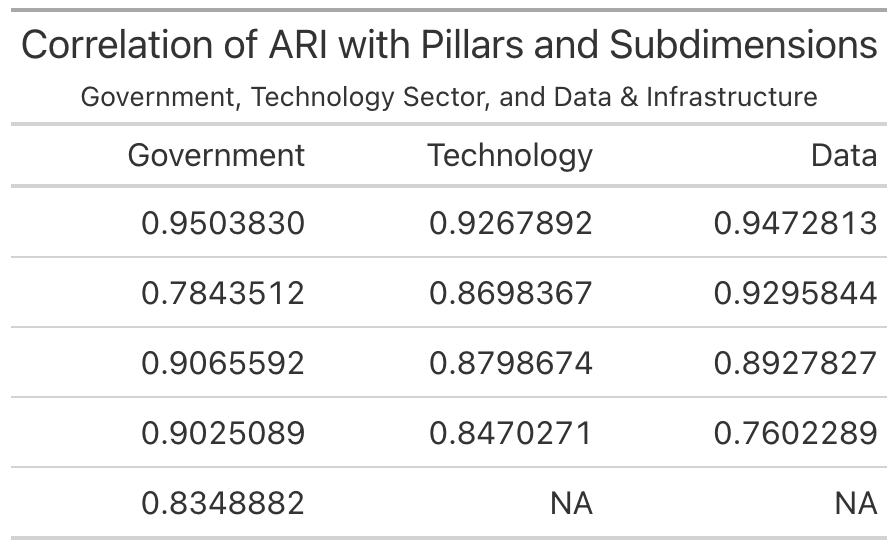
We also examined the correlation between each dimension and the AI readiness score. Each pillar shows a very high correlation with the overall AI Readiness Index (ARI), which is expected given that the pillars directly contribute to the total score. More informative are the subdimensions that correlate less strongly with the ARI. In particular, Vision, Data Representativeness, and Adaptability exhibit the weakest correlations, suggesting that performance in these areas varies more independently from a country’s overall readiness. In contrast, Infrastructure, Governance and Ethics, and Digital Capacity show the strongest associations with the ARI, indicating that these components are central drivers of overall AI readiness across countries.
Relative Importance
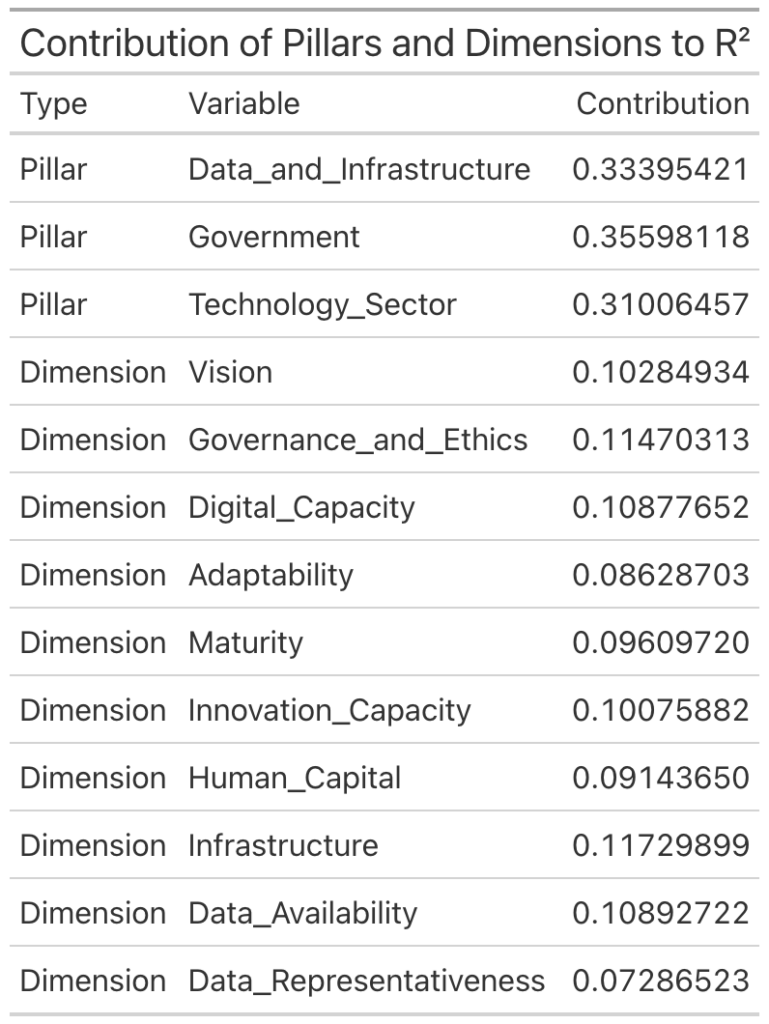
Using the relaimpo package in R, we were able to extract the relative importance of each pillar and dimension. Our results showed relatively even spread across the dimensions (represented in the first three rows) and pillars (represented in the last ten rows). Government contributed slightly more to the cross-country ARI variance, but overall, the three pillars contribute similarly. The relative importance of each dimension was also quite balanced, with Infrastructure and Governance and Ethics contributing the most, and Data Representativeness and Adaptability contributing the least.
Zamir (2025)’s research shows that countries’ performance is usually better when they have higher digital capacity. By Zamir’s definition, digital capacity refers to countries who make huge investments in higher education and innovation in digital aspects. This is the most important factor for AI to develop at a faster pace and in a more sustainable way. This happens to perfectly explain the reason why Infrastructure is one of the highest pillars in AI development contribution. Countries with a long period in investing Stem education and research ecosystems naturally have higher AI readiness rate. The first visualization overall concludes that AI readiness is most related to digital infrastructure and government policies. The cultural background is relatively unimportant.